

内容简介
你可能不擅长做饭,但你很可能有一道自己最享受的美食。不过,你知道如何用英语描述用筷子“夹”,用勺子“舀”等在享受美食时的简单动作吗?听节目,跟主持人 Beth 和步理学习如何用英语描述在使用餐具和厨具时的动作。
文字稿
(关于台词的备注: 请注意这不是广播节目的逐字稿件。本文稿可能没有体现录制、编辑过程中对节目做出的改变。)
Buli
大家好,欢迎收听 BBC 英语教学的 “你问我答” 节目。We are here to answer your questions about English language, culture and life. I'm Buli and Beth is here to help me answer this week's question.
Beth
Hi, Buli. How are you?
Buli
Well, the weather is getting colder and colder, so I'm very hungry for a stew lately. Talking about cooking, let's hear the question.
Question
我在和英国朋友聊做饭和吃饭的时候发现,我不太清楚怎么用英语说 “用筷子夹”、“用勺子舀”、“用叉子叉”、“用牙签挑” 等等描述使用餐具的动作。请问可以介绍一些吗?
Beth
Great question, and very interesting. Now, with a lot of the utensils you've mentioned, it's common to use the verb 'use'.
Buli
Ah yes. For example, you 'use' a spoon to eat cereal, but there are other verbs we'll teach you too. 在本期节目中,就让我们来分享一些能用来描述使用各种餐具的动作的动词。Let's get started.
Beth
We use chopsticks to 'pick something up'. For example, if I have ramen that has broccoli in it, I'll 'pick the broccoli up' using the chopsticks.
Buli
That's right. Or to eat rice, you would 'pick it up' using chopsticks.
Beth
Now, a fork has some different functions. You can 'spike' or 'stab' food with a fork.
Buli
Yes. For example, to eat a piece of chicken, you'd use the prongs on the fork to pick it up. When you push the fork prongs into the food, you are 'spiking' or 'stabbing' the food.
Beth
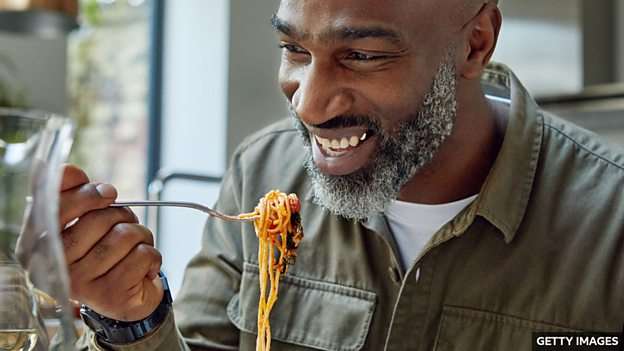
But the words 'stab' and 'spike' can sound a bit negative, so they're not that common. We're still more likely to just say you 'use' a fork, or 'pick something up' with a fork. But if you're eating spaghetti or noodles, you can 'twirl' them onto your fork – this means rotate the fork to get the spaghetti or noodles around it, which makes it easier to eat.
Buli
在使用筷子和叉子时,我们都可以用 “pick up” 这个短语动词来描述 “夹” 或者 “叉” 一样东西。在使用叉子时,我们还可以用 “twirl” 来描述 “把面条等细长的东西用叉子卷起来” 这个动作。
Now, what about a spoon? We can 'stir' a liquid with a spoon, like a sauce or a cup of tea – that means use the spoon to move the liquid around in a circular motion.
Beth
Yes, and you can also use a spoon to 'mix' an ingredient in. If I'm making a cake, I'll 'mix' the flour into the butter and sugar using a spoon.
Buli
And you can also 'scoop' something onto a plate using a spoon, particularly if the dish has a sauce or isn't completely solid.
Beth
Now you can use a knife to 'chop' or 'slice'. This means cut something into pieces. Buli, last night I made a pie, and I chopped some carrots and potatoes, and sliced an onion and some mushrooms.
Buli
Delicious! You can also 'dice' using a knife. This means cut something into small cubes. 在使用勺子时,我们可以用 “mix” 来描述 “搅拌,混合” 等动作,或者用 “scoop” 来描述 “用勺子挖或舀比较浓稠的酱料或固体状的东西”。而在使用餐刀或者菜刀时,除了 “cut”,我们通常还可以用动词 “chop” 来表示 “剁”,用 “slice” 来表示 “切开,切成薄片”,或者用 “dice” 来表示 “切成小块”。
你正在收听的是 BBC 英语教学的 “你问我答” 节目。刚刚我和 Beth 分享了一些描述使用筷子和刀叉等餐具的动作的动词。那么,像是 “锅铲” 和 “擀面杖” 等厨具又可以搭配哪些动词呢?Beth, what about cooking utensils? Like a spatula or a rolling pin, for example?
Beth
Well, we can use a spatula to 'flip' food. If I fry a burger in a pan, I use a spatula to 'flip' it over to cook the other side.
Buli
And we can also 'serve' food with a spatula – we use it to move the food onto our plates.
单词 “flip” 可以用来描述用锅铲 “给……翻面” 或者 “翻动……” 的动作。我们还可以用 “serve” 这个词来表达 “把做熟的饭菜用锅铲从锅里盛出来”,也就是 “出锅”。
Beth
The verb we use with 'sieve' is 'sieve'. I 'sieve' flour into my bowl when making a cake. A similar utensil to a sieve is a colander. Now this has larger holes than a sieve and the verb we use here is 'drain'. I 'drain' my pasta using a colander to get rid of the water.
Buli
And we use a rolling pin to 'roll' dough. 在做面点时,我们可能会经常用到 “sieve(筛子)”、“colander(滤碗)” 和 “rolling pin(擀面杖)” 等工具。其中,单词 “sieve” 既可以做名词,也可以做动词,描述 “过筛” 这个动作。我们可以用 “drain” 来描述 “用滤碗滤干水分或者汤汁”。而在使用擀面杖时,我们可以用 “roll” 来形容 “把面擀平” 这个动作,比如 “roll cookie dough(把饼干面团擀平)”。
Beth
Cookies? I think we should go, I'm hungry! Remember, if you have a question that you'd like us to answer, you can email us too at: questions.chinaelt@bbc.co.uk
Buli
你还可以通过微博向我们提问。我们的微博账号是 “BBC英语教学”。Bye!
Beth
Bye!