

本集内容
Why do we love dogs?
我们为什么喜爱狗?
文字稿
How did we go from this to this?
我们是怎么让这种动物变成这样的?
That's right. All dogs, even tiny chihuahuas, descend from ancient wolves.
没错。所有的狗,即使是体型娇小的吉娃娃,都是古代狼的后裔。
Scientists think they became dogs about 20,000 to 40,000 years ago – the first animal ever to be domesticated.
科学家认为,它们在大约 2 万到 4 万年前变成了狗,是第一种被驯化的动物。
One theory is that humans captured wolf pups and bred them on purpose.
一种理论认为,人类捕获了狼的幼崽并有意地繁育了它们。
Another is that friendlier wolves hung around human camps for food, and over generations, those traits stuck.
另一种理论认为,相对友善的狼会在人类营地周边徘徊以获取食物,经过世代的演变,这些习性留存了下来。
Either way, scientists agree that the relationship was useful for both parties.
无论真相如何,科学家们都一致认为,人和狗之间的关系对双方都有所裨益。
Early dogs acted as guards and hunting partners.
早期的犬类扮演了守卫和狩猎伙伴的角色。
Selective breeding for specific traits has created the hundreds of breeds we see today.
为了获得某些特征而进行的选择性育种创造出了今天我们所看到的数百个品种。
A lot of dogs still work for us, but many are now treated as family.
虽然仍有许多狗在为我们工作,但很多狗现在已经被当作我们的家庭成员了。
Studies suggest that dogs have even evolved to look as cute as possible to humans right when their mums would abandon them.
研究发现,有些狗甚至演化出了一种策略:在它们的母亲离开它们的时候,外表长得尽可能让人类觉得可爱。
But there's more.
但还远不止这些。
Neuroscientist Gregory Berns discovered through dog brain scans that the area linked to joy lit up more when they smelled their humans compared to strangers.
神经科学家格雷戈里·伯恩斯通过研究狗的大脑扫描发现,它们大脑中和愉悦相关的区域在它们闻到主人时比闻到陌生人时更活跃。
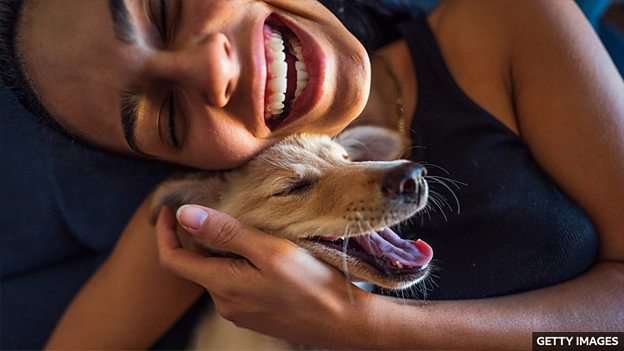
So maybe we just can't help loving them – and the feeling is mutual.
所以,也许我们就是无法抗拒对它们的喜爱,而且这种感觉是相互的。
重点词汇及表达
descend from 是…的后裔
be domesticated 被驯化
hang around 徘徊
selective breeding 选择性育种
mutual 相互的,共同的