

从规律的盈亏圆缺到罕见的色彩幻变,月亮总是带给人无限惊喜。为什么月相的变化如此有规律?哪些瑰丽的月色又是如何形成的?本文浅谈月亮外形的变化规律和背后的原因。
词汇:astronomy 天文学
1 You may have heard of the idiom 'once in a blue moon' to describe an event that doesn't happen often. But can the Moon really be blue? Our closest neighbour in this vastgalaxy, the Moon, orbits the Earth like a natural satellite. Unlike many of the other planets in our Solar System, ours only has the one moon. If you flew to it, you would land on grey rocks. This is because the lunar surface is made from mostly magnesium, iron and other minerals of that colour. But, if you're lucky to have clear skies under the curtain of night, you may be able to admire its luminosity. You might even see that it seems to change shape and hue.
2 It's important to understand that the Moon reflects light from the Sun as it orbits the Earth, and that light bounces back to the Earth. The position of the Moon, Sun and the Earth determines how much of the Moon we see. The new Moon appears almost invisible in the sky as it is in total darkness. This is the opposite to the full Moon which is completely lit up. There are eight different phases to the lunar cycle between a full Moon and a new Moon, each lasting around 28 days. In fact, the word 'month' takes its root from 'Moon' because it was almost equal to the lunar phases.
3 The other phases include the crescent, quarter and gibbous phase. Crescent originates from the Latin verb 'crescere', meaning 'to increase', and so it is the phase just before and after a new Moon as it takes a concave shape. The quarter will show half of the Moon. 'Gibbous' gets its root from the Latin term 'gibbus' which applied to the Moon's convex shape. These shapes are determined by the adjectives 'waning', to get smaller, and 'waxing', to get bigger.
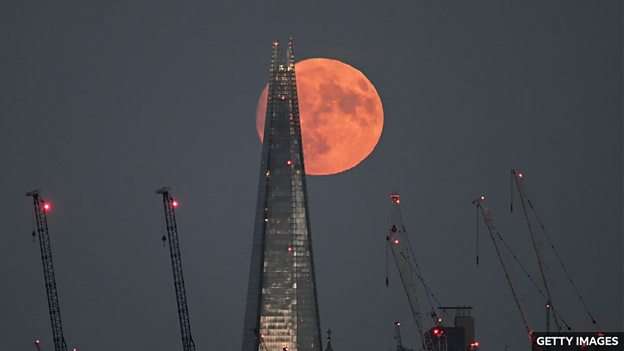
4 So now you know how we've named the shapes, what about those mesmerising colours? The light waves that reach our eyes can vary due to the Moon's position on the horizon and pollution. This is known as Rayleigh scattering. When the Moon is low, light travels through the densest part of the atmosphere and shorter waves of blue scatter away. This leaves only the red and orange light waves to reach us. A warmer atmosphere, as well as smoke from wildfire, may increase the scattering effect as well, making the Moon appear less dull in spring and summer. This is why it's more likely for you to look up and see a pink Moon in April, a golden Moon in May and July, and even a red coloured Moon in the month of June.
测验与练习
一、将标题和段落配对。
Paragraph 1 _______
Paragraph 2 _______
Paragraph 3 _______
Paragraph 4 _______
a. How do we see the Moon?
b. The different colours of the Moon
c. The different shapes of the Moon
d. Our Moon
e. Things we can find on the Moon
二、根据文章内容选出正确的选项。
1. We are the only planet in the Solar System with one Moon.
a. True
b. False
c. Not given
2. The Moon is grey because…
a. the light reflected from the Sun is dull.
b. the rocks are made of grey minerals.
c. we see it through grey clouds.
3. What is the opposite of a new Moon?
a. a dark sky with an invisible Moon
b. a bright Moon, only half full in shape
c. a completely lit up Moon, full in shape
4. Which of these adjectives describes something that is growing?
a. waning
b. waving
c. waxing
5. We see the most mesmerising colours of the Moon when it is high in the sky.
a. True
b. False
c. Not given
三、用下列单词完成对本文的总结。
It does feel rather 1) _______ to look out onto the 2) _______ and see a brightly coloured Moon. The 3) _______ of the Moon is determined by how low or high it is in the sky and the 4) _______ of light waves in our atmosphere. Whereas the shape is determined by where the Moon as it 5) _______ our Earth.
dull
horizon
hue
mesmerising
orbits
scattering
Solar System
(答案见词汇表后)
词汇表
vast 巨大的
galaxy 星系
orbit 沿轨道围绕…运行
satellite 卫星
Solar System 太阳系
lunar 月亮的
luminosity 光度,亮度
hue 色调,颜色
reflect 反射
invisible 看不见的
light up 照亮
phase 阶段
cycle 周期
root 词根
concave 凹的,凹面的
convex 凸的,凸出的
mesmerising 令人着迷的
light wave 光波
horizon 地平线
scattering 散射
densest 密度最大的,最浓密的
dull 暗淡的
答案
一、将标题和段落配对。
Paragraph 1 d) Our Moon
Paragraph 2 a) How do we see the Moon?
Paragraph 3 c) The different shapes of the Moon
Paragraph 4 b) The different colours of the Moon
二 、根据文章内容选出正确的选项。
1. a. True. Unlike many of the other planets in our Solar System, ours only has the one Moon.
2. b. … This is because the lunar surface is made from mostly magnesium, iron and other minerals of that colour.
3. c. … The new Moon appears almost invisible in the sky as it in total darkness. This is the opposite to the full Moon which is completely lit up.
4. c. These shapes are determined by the adjectives "waning", to get smaller, and "waxing", to get bigger.
5. b. False. When the Moonis low, light travels through the densest part of the atmosphere and shorter waves of blue scatter away. This leaves only the red and orange light waves to reach us. The mesmerising colours do not appear when the Moon is high.
三、用下列单词完成对本文的总结。
It does feel rather mesmerising to look out onto the horizon and see a brightly coloured Moon. The hue of the Moon is determined by how low or high it is in the sky and the scattering of light waves in our atmosphere. Whereas the shape is determined by where the Moon as it orbits our Earth.